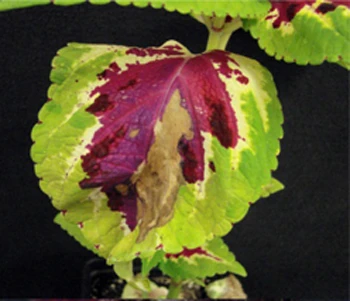
In 2005, downy mildew (Peronospora sp.) was found on coleus in New York and Louisiana. A year later the disease was found throughout most of the U.S. Both seed and vegetatively-propagated varieties are susceptible. The fungus reproduces via specialized spores called sporangia that may sometimes be seen on the underside of the coleus leaves. Sometimes these sporangia are few in number and require a microscope to see. Other times, high numbers of sporangia are produced forming a visible grayish fuzz on the leaf undersides.
Mich. St. Univ. plant pathologist Mary Hausbeck and research technician Blair Harlan said a combination of control methods, including practicing good sanitation, maintaining a low relative humidity and applying effective fungicides can help to prevent downy mildew problems.
* Purchase quality plant material from reputable sources.
* Early detection aids in timing fungicide applications. An early symptom is necrotic spotting on the leaves.
* Keep greenhouse air moving whenever possible so that the relative humidity is kept low. For outdoor production, arrange plants in rows to take advantage of prevailing winds that can dry the foliage.
* Choose effective fungicides and reapply frequently especially when the weather favors the disease. Thoroughly cover the plants with the fungicide sprays.
* Dispose of or destroy all plants with downy mildew at a location far from production areas. Avoid cull piles where the downy mildew fungus can survive and cause problems for new crops.
Pictured: Downy mildew symptoms on coleus include brown blotches on leaves, leaves dropping off of plants and stunted seedlings.
Photo by Mary Hausbeck, Mich. St. Univ.
Latest from Greenhouse Management
- The Growth Industry Episode 10: State of the Horticulture Industry
- Millennium Pacific Greenhouses launches California Grown Cucumber Program
- Scientists develop vitamin A-enriched tomato to fight global deficiency
- Tennessee Green Industry Field Day scheduled for June 11
- UTIA and UT Knoxville research teams will develop automated compost monitoring system
- Ken and Deena Altman receive American Floral Endowment Ambassador Award
- [SNEAK PEEK] Leading Women of Horticulture: The women of Fairview Greenhouses & Garden Center
- [SNEAK PEEK] Leading Women of Horticulture: The inventive women of TPIE ’26